
The Tank and the Ocean
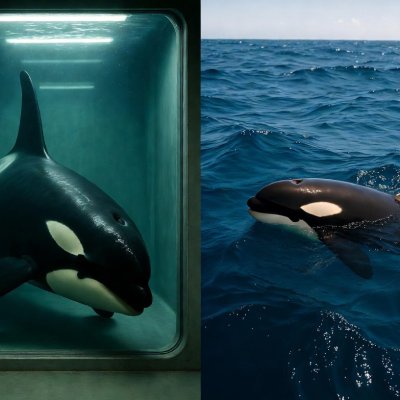
There is a well-documented fact about orcas that still unsettles people when they first hear it: in the wild, these animals have never been recorded killing a human being. Not once. For all their size, intelligence, and capacity for coordinated violence against seals, whales, and even great white sharks, free-living orcas simply do not treat humans as prey or as enemies. They investigate, they sometimes play, they occasionally mistake a surfer in a black wetsuit for a seal and then stop. But they do not attack us with fatal intent.
Then There Is Tilikum
Captured as a two-year-old calf off Iceland in 1983, Tilikum spent the rest of his life in tanks. At Sealand of the Pacific he shared a cramped enclosure with two older females who routinely raked him with their teeth. At night the three whales were locked into a metal module roughly the width of a small living room for up to fourteen hours. Later, at SeaWorld Orlando, the concrete world continued. The shows, the isolation, the absence of distance, of family structure, of the long-range acoustic and social life an orca is built for. Over three decades the environment did what prolonged environmental trauma does. Tilikum became involved in the deaths of three people. The most public was the killing of trainer Dawn Brancheau in 2010. He died in 2017 from a progressive lung infection, still in captivity.
The contrast is almost too clean. Same species. Same capacity for power and complex emotion. One group never harms us. One individual, subjected to years of confinement, social disruption, sensory restriction and forced performance, eventually does. The difference is not genetics. It is the tank.
Now Look at Us
Human beings are not orcas, and the parallel is imperfect. We are not kept in concrete pools by ticket-selling corporations. Yet many of us live inside subtler versions of the same structure: prolonged, low-grade, cumulative environmental trauma that never announces itself with a single dramatic event. It arrives as the everyday and the unseen.
It is the slow erosion of belonging when family is fragmented and community is optional. It is the constant low-level threat of social evaluation delivered through a screen that never switches off. It is the absence of meaningful challenge and the presence of endless stimulation that never quite satisfies. It is the quiet message, repeated for years, that certain emotions, especially in young men, are liabilities to be managed rather than signals to be understood. It is economic precarity dressed up as “hustle,” isolation framed as independence, and the loss of any coherent story about what a life is for.
None of these things looks like trauma when examined in isolation. Each is ordinary. Together they form an environment. And environments shape minds. Just as the tank reshaped Tilikum’s behaviour until the behaviour became dangerous, the cumulative pressure of these smaller forces can reshape human psychology until the outcomes appear as aggression, withdrawal, self-destruction, or the quiet collapse we politely call “mental health issues.”
We are skilled at noticing the spectacular traumas. Abuse, catastrophe, overt violence. We are far less skilled at recognising the quieter kind. The kind that does not leave a single identifiable wound but, over years, changes the animal’s relationship to itself and to others. The kind that makes the ocean feel unreachable even when the person is still swimming in it.
This is not an argument that every difficult feeling is trauma, or that people have no agency. It is an observation about dose and duration. Orcas in the wild face hardship, competition, injury and loss. They do not become what Tilikum became. The difference is the sustained mismatch between the animal’s design and the conditions it is forced to inhabit. Human beings are not so different. We are social, meaning-seeking, physically capable creatures who evolved for far more movement, risk, face-to-face belonging and purposeful difficulty than many modern environments supply. When those conditions are chronically withheld or distorted, the psyche adapts in ways that can look like damage.
The useful question is not simply “What is wrong with this person?” but “What kind of tank has this person been living in?” Sometimes the tank is obvious. More often it is made of ordinary materials: missed connections, unprocessed grief, chronic comparison, the absence of elders who know how to initiate rather than merely manage, the substitution of performance for presence.
Tilikum’s story is not primarily a story about a killer whale. It is a story about what happens when a complex mind is kept too long in conditions that deny its nature. The wild orcas remain a quiet rebuke. They show us what the same species looks like when the environment matches the design.
For those of us working with young people whose distress does not always have a single clear origin, the parallel is worth sitting with. Not every crisis is the result of one catastrophic event. Sometimes it is the long accumulation of the unseen. The work, then, is not only to treat the symptoms that emerge when the pressure finally breaks through. It is also to help people recognise the tanks they have been swimming in, and, where possible, to widen the walls or open a channel back toward deeper water.
The ocean is still there. The question is whether we can still reach.
Tim Baker
National Director, Kiwis For Good